The GRA has announces a short postponement of the GHC1 fuel levy implementation, now set to begin on June 16, allowing stakeholders time to adjust to the new rates.
The Ghana Revenue Authority (GRA) has postponed the implementation of the GHC1 fuel levy to June 16, 2025, following strong opposition from the Chamber of Oil Marketing Companies (COMAC) and other stakeholders. This decision was made after discussions between the GRA and COMAC in a bid to address concerns over the timing and potential impact on fuel prices and consumer burden.
Background of the Fuel Levy
The Energy Sector Shortfall and Debt Repayment Levy aims to raise additional revenue to address energy sector shortfalls, reduce legacy debts, and stabilize the country’s power supply. The levy was initially set to take effect on June 9, 2025, but was postponed due to stiff resistance from oil marketing companies.
New Levy Rates
The revised levy rates will affect various petroleum products as follows:
– Motor Spirit (Super Petrol)*: GHC1.95 per liter (up from GHC0.95)
– Diesel (AGO) and Marine Gas Oil (Foreign): GHC1.93 per liter (up from GHC0.93)
– Marine Gas Oil (Local): GHC0.23 per liter (up from GHC0.03)
– Heavy Fuel Oil (Residual Fuel Oil – RFO): GHC0.24 per liter (up from GHC0.04)
– Partially Refined Oil (Naphtha): GHC1.95 per liter (up from GHC0.95)
– Liquefied Petroleum Gas (LPG): No change, remains at GHC0.73 per kilogram
Transitional Arrangements
To manage the transition, the GRA has outlined key directives:
– Products lifted by Petroleum Product Marketing Companies (PPMCs) before June 16 will still be subject to the old levy rates.
– “Cash-and-carry” transactions by PMMCs for products lifted on or after June 1, 2025, will be subject to the new rates.
Stakeholder Reactions
COMAC had expressed strong opposition to the initial implementation date, citing inadequate industry consultation and potential disruption to operations. They described the GRA’s handling of the matter as an “institutional ambush” and “Rambo-style directive”. The postponement reflects the value of dialogue and partnership among stakeholders, allowing industry players adequate time to adjust to the new levy rates.
Portugal has won the UEFA Nations League after beating Spain 5-3 on penalties in Sunday’s final in Munich.
Copyright Matthias Schrader/Copyright 2025 The AP. All rights reserved
Portugal defeated Spain in penalty kicks 5- 3 to win the Nations League final late on Sunday after both sides failed to score in extra time following a showdown that ended 2-2 in normal time.
After Nuno Mendes, Bruno Fernandes, Vitinha, and Goncalo Ramos all smoothly scored their penalties, Portugal goalkeeper Diogo Costa saved Spain’s Álvaro Morata’s spot kick before Neves converted his team’s fifth to seal the win.
Portugal goalkeeper Diogo Costa stops a penalty shot by Spain’s Alvaro Morata during the Nations League final soccer match between Portugal and Spain at the Allianz Arena Michael Probst/Copyright 2025 The AP. All rights reserved
The win marks the second Nations League trophy for Portugal after lifting the trophy in the inaugural edition in 2019.
Portugal’s Francisco Conceicao lifts the trophy up as he celebrates with teammates [Angelika Warmuth/Reuters]
Portugal’s victory against its neighbours was hard-fought, as the Seleção had come back twice from behind. Cristiano Ronaldo sent the match to extra time when he equalised in the 61st minute with his record-extending 138th goal for Portugal.
Cristiano Ronaldo all smiles after hauling Portugal level again: Getty Images
The 40-year-old Ronaldo went off to a standing ovation and a hug from coach Roberto Martínez in the 88th.
The keenly contested game seemed destined for Spain after Mikel Oyarzabal had given Spain a 2-1 halftime lead. Oyarzabal squeezed the ball past Portugal goalkeeper Diogo Costa in the 45th minute after Pedri played him through on goal.
It was also Spain who drew the first blood after Martin Zubimendi broke the deadlock in the 21st minute with a tap-in when Portugal’s defence failed to deal with Lamine Yamal’s cross.
Martin Zubimendi wheels away after scoring the opening goal for SpainGetty Images
Five minutes later, Portugal responded with Nuno Mendes levellingby drilling a low shot inside the far post.
Photo courtesy: Getty Image. Ken Ofori-Atta is said to be out of the country for medical reasons
Ghana’s former finance minister Ken Ofori-Atta has been placed on Interpol’s red notice list for allegedly using public office for personal gain.
This comes after Ghanaian prosecutors declared him a wanted person as well as a fugitive from justice, as he was outside the country, over his alleged involvement in several corruption cases when he was in government.
A red notice is not an arrest warrant but a request to police worldwide to detain someone pending extradition.
Ofori-Atta, who is said to be out of the country for medical reasons, has not commented on the allegations, but he has said he has been unlawfully treated.
The AFP news agency is quoting Frank Davies, on Ofori-Atta’s legal team, criticising the prosecutor’s approach.
“We submitted medical records in good faith, and the office has chosen to ignore them,” Mr Davies told AFP.
“The special prosecutor is not being sensitive to the issues at hand, especially knowing that Mr Ofori-Atta is unwell and receiving treatment.”
The 65-year-old has been accused of causing financial losses to the state.
The allegations include questions over procurement procedures in the building of a controversial national cathedral, which remains a hole in the ground despite the alleged spending of $58m (£46.6m) of government money.
Ofori-Atta’s lawyers had offered to represent him but the state prosecutor said they could not respond to criminal charges on behalf of their client.
In February, Ofori-Atta appealed to the Office of the Special Prosecutor (OSP) to remove his name from the wanted list and provided a definite return date in May.
State prosecutor Kissi Agyabeng accepted Ofori-Atta’s assurance and subsequently took his name off the wanted list.
But in March Ofori-Atta filed a lawsuit, claiming unlawful treatment and requesting removal of related content from the OSP’s social media platforms.
Early this month, Ofori-Atta was re-declared a wanted person and a fugitive from justice after failing to appear before an investigative panel.
Agyebeng subsequently formally initiated the Red Notice request, seeking international help in tracking down the former official, local media reported.
“We want him here physically, and we insist on it. A suspect in a criminal investigation does not pick and choose how the investigative body conducts its investigations,” Agyebeng said.
In the Red Notice released on late Thursday, Interpol said Ofori-Atta is wanted on charges of “using public office for profit”.
He was finance minister from January 2017 to February 2024, when the New Patriotic Party (NPP) was in power.
The NPP lost last December’s elections to the National Democratic Congress.
President John Mahama, who was inaugurated in January, went on to establish an investigative committee known as Operation Recover All Loot.
The committee has received over 200 complaints of corruption, amounting to more than $20bn in recoverable funds.
Mahama has directed the attorney general and minister of justice to launch investigations into these allegations, stating that Ghana will no longer be a safe haven for corruption.
However, some Ghanaians have criticised him for discontinuing cases against his former allies on trial.
Spain’s players celebrate at the end of the UEFA Euro 2024 semi-final football match between Spain and France at the Munich Football Arena in Munich on July 9, 2024. Miguel MEDINA / AFP
Spain’s teenage sensation Lamine Yamal inspired his country to a thrilling 5-4 win over France on Thursday to send the holders through to their third successive Nations League final where they will face Iberian neighbours Portugal.
The European champions dazzled in the first half of the semi-final at the MHP Arena with fine goals by Nico Williams and Mikel Merino inside 25 minutes to race into a 2-0 lead.
Spain’s 17-year-old starlet Yamal then got in on the act to coolly add a third from the penalty spot nine minutes into the second half before his Barcelona teammate Pedri clipped a sublime fourth into the net less than a minute later.
The goals continued to flow as France striker Kylian Mbappe also slotted home from the penalty spot near the hour mark before Yamal added Spain’s fifth after 67 minutes to cap an exhilarating individual performance.
France then mounted an extraordinary comeback as a stunning strike from Rayan Cherki, Dani Vivian’s own goal and a Randal Kolo Muani finish caused Spain some late jitters but they held on to book a clash with their Portuguese rivals on Sunday.
The National Road Safety Authority (NRSA) has imposed sanctions on nine transport companies and unions for failing to comply with mandatory registration requirements and regulatory notices. The affected entities include:
Transport Companies
– Express Transport
– AY Transport
– Dikyebu Transport
– Ghana Express
– KEK Transport
– Nasara Transport
– V3 Express
– *Transport Unions:*
– Commercial Transport Union
– Vigilante Transport Union
Penalties and Suspension
The NRSA has imposed a total administrative penalty of GH₵ 462,000 on the nine entities. Each offending transport entity is liable to pay a monetary penalty of:
– *GH₵ 6,000* for non-registration
– *GH₵ 60,000* for non-compliance with lawful notices
The NRSA has also ordered the immediate suspension of operations against Express Transport and six other commercial road transport companies until they comply with the notices or face additional sanctions.
NRSA’s Stance
Photo courtesy: GBC
According to Director-General of NRSA, Abraham Amaliba, “The Authority is in an enforcement mode and will not bend the rules for anyone. The task of improving service quality begins with recognising which entities work within our operational space.”
Registration Requirement
The NRSA Act and Regulations require all commercial road transport operators, institutional transport units, school bus services, ride-hailing firms, tyre service centers, and vehicle maintenance workshops to register with the Authority. The regulation became enforceable on March 30, 2025, aiming to improve accountability, service quality, and road safety standards in Ghana’s transport ecosystems.
The Trump administration has signed a proclamation temporarily restricting student visas for foreign students at Harvard University, citing concerns over foreign ties and campus safety. The ban, set to last six months, also directs the US State Department to consider revoking academic or exchange visas for current Harvard students who meet certain criteria.
Harvard’s Response
Harvard University has condemned the move, calling it “illegal” and vowing to protect its international students. “Harvard will continue to protect its international students,” the university stated, adding that the administration’s actions violate Harvard’s First Amendment rights.
Background of the Dispute
The row between Harvard and the Trump administration began when Trump accused the university of failing to protect Jewish students after an attack in 2023. The administration has since launched multiple attacks on Harvard, including freezing billions of dollars in grants and proposing to end its tax-exempt status. This has led to a series of legal battles between the two parties.
Legal Action
In May, Homeland Security Secretary Kristi Noem announced the revocation of Harvard’s Student and Exchange Visitor Program certification, which was blocked by US District Judge Allison Burroughs. Harvard has sued the Trump administration, arguing that the move is “undisguised retaliation” and would inflict irreparable harm on the university and its students.
Impact on International Students
About 25% of Harvard’s student body comprises international students, who hail from over 140 countries. The university argues that the administration’s actions would devastate its academic operations and the lives of affected students and staff. Harvard President Alan Garber has condemned the move, stating that international students are “our classmates and friends, our colleagues and mentors, our partners in the work of this great institution”.
In a return of one of the most controversial policies of his first term, President Donald Trump signed a proclamation Wednesday banning nationals from a dozen countries, including Afghanistan, Haiti and the Republic of Congo, from entering the United States.
Trump framed the new restrictions, which primarily target African and Asian countries, as necessary to fortify national security and combat terrorism.
“As President, I must act to protect the national security and national interest of the United States and its people. I remain committed to engaging with those countries willing to cooperate to improve information-sharing and identity-management procedures, and to address both terrorism-related and public-safety risks,” the proclamation read.
Nationals of 12 countries will be barred from entering the United States: Afghanistan, Myanmar, Chad, Republic of Congo, Equatorial Guinea, Eritrea, Haiti, Iran, Libya, Somalia, Sudan and Yemen.
Several of the countries on the list, according to Trump’s proclamation, regularly declined to accept the return of their nationals or had visa overstay rates the administration deemed “unacceptable” and indicative of “a blatant disregard for United States immigration laws.”
Others on the list, like Sudan, Yemen and Somalia, were included for inadequate screening and vetting measures, the proclamation noted.
An additional seven countries came under partial travel restrictions, in which entrance into the country under several visa programs was suspended but an outright ban was not implemented. Those countries are Burundi, Cuba, Laos, Sierra Leone, Togo, Turkmenistan and Venezuela.
The proclamation includes exemptions for any lawful permanent resident of the United States, recipients of Afghan Special Immigrant Visas, diplomatic visas, immediate family member immigrant visas and visas “for ethnic and religious minorities in Iran.” It also included exceptions for adoptions, dual nationals traveling on passports from unrestricted countries and athlete or members of athletic teams traveling to the country for the World Cup or the Olympics.
The travel restrictions are set to go into effect at 12:01 a.m. ET Monday.
The travel ban risks worsening already strained geopolitical tensions, with the United States’ role on the global stage having been shaken in recent months by Trump’s efforts to enact tariffson dozens of countries nationwide, cut humanitarian aid to poorer nations and force countries to accept immigrants he’s seeking to deport while punishing those that do not.
“A recent terror attack in Boulder, Colorado, has underscored the extreme dangers posed to our country by the entry of foreign nationals who are not properly vetted, as well as those who come here as temporary visitors and overstay their visas. We don’t want them,” Trump said.
The suspect in the attack, Mohamed Sabry Soliman, is from Egypt, and he entered the country on a tourist visa before he applied for asylum. His tourist visa expired as his asylum case was pending. Egypt is not on the list of countries under the newly announced travel bans.
Soliman’s family were taken into custody by Immigration and Customs Enforcement on Tuesday and were being processed for removal proceedings, according to Homeland Security Secretary Kristi Noem. A judge subsequently issued an order Wednesday to prevent the deportation of Soliman’s wife and five children.
Trump added that his administration considered “the large-scale presence of terrorists, failure to cooperate on visa security, inability to verify travelers identities, inadequate record-keeping of criminal histories, and persistently high rates of illegal visa overstays” in determining the countries that would be affected by the ban.
Alex Nowrasteh, the vice president for economic and social policy studies at the Cato Institute, a nonpartisan and independent public policy research organization, noted that even though Trump cited terrorism-related concerns in announcing the new restrictions, terrorist attacks by people from the 12 countries facing outright bans are rare.
“A single terrorist from those countries murdered one person in an attack on US soil: Emanuel Kidega Samson from Sudan, who committed an attack motivated by anti-white animus in 2017. The annual chance of being murdered by a terrorist from one of the banned countries from 1975 to the end of 2024 was about 1 in 13.9 billion per year,” Nowrasteh wrote.
The new travel restrictions mark the return of one of the most divisive policies of Trump’s first term, a 2017 travel ban that he called one of his “most successful policies” Wednesday.
During his first term, Trump similarly banned foreigners from six Muslim-majority countries from entering the United States, citing terrorism concerns. Despite Democratic backlash and several legal challenges to the effort, the Supreme Court ultimately upheld the policy in a split decision, with Chief Justice John Roberts making it clear that the ability to regulate immigration falls within the president’s purview.
The president can block non-nationals from coming into the United States, Roberts said at the time, if the determination is made that allowing them to enter “would be detrimental to the interests of the United States.” Meanwhile, Justice Sonia Sotomayor wrote in her dissent that based on the evidence in the case, “a reasonable observer would conclude that the Proclamation was motivated by anti-Muslim animus.”
Iran, Libya, Somalia and Yemen are the only countries included across both of Trump’s travel bans.
Those restrictions remained in place until Jan. 20, 2021, when then-newly elected President Biden overturned them after he signed a proclamation titled “Ending Discriminatory Bans on Entry to The United States.”
Trump has for years expressed a desire to limit immigration from Haiti and African nations, deriding them as “shithole” countries and making clear his preference for European immigrants in discussing the visa lottery system at a White House meeting in 2018.
Shortly after he took office for the second time, Trump limited refugee admissions from almost all countries, including Afghanistan, Sudan, the Republic of Congo and Myanmar. In May, however, he granted refugee status to 59 South Africans from the white ethnic group that ruled South Africa during apartheid.
The Supreme Court allowed the Trump administration Friday to revoke the temporary legal status of more than 500,000 immigrants that was granted by the Biden administration, making them subject to deportation. Those parolees came from Cuba, Haiti, Nicaragua and Venezuela.
The Trump administration canceled an extension of Haiti’s Temporary Protected Status in February after the Biden administration extended the designation into 2026 because of violence and political turmoil on the island. It has also undertaken similar attempts to end TPS for the millions of Venezuelans who entered the country under the protection.
Portugal players applaud their fans at full time photo courtesy: Getty Images
Ronaldo’s 68th-minute tap in, a record-extending 137th international goal, sealed a first win over Germany after five losses.
Francisco Conceição enjoys his equaliser for Portugal with his teammates photo courtesy Getty Images
In a thrilling UEFA Nations League semi-final match, Portugal defeated Germany 2-1, securing a spot in the final. Cristiano Ronaldo scored the winning goal, his 137th international score, in the 68th minute.
Florian Wirtz (17) celebrates his opener Photo courtesy: Getty Images
Germany took the lead in the 48th minute when Bayer Leverkusen forward Florian Wirtz headed in a cross from Joshua Kimmich, who earned his 100th cap in the match. The goal was contentious, with Portugal arguing that German debutant Nick Woltemade had obstructed defender Ruben Dias. Despite the referee reviewing the play on a pitchside monitor, the goal was allowed to stand.
Portugal equalized in the 63rd minute when substitute Francisco Conceicao scored a brilliant goal, curling a shot past Marc-Andre Ter Stegen from the right touchline. Conceicao had only joined the match five minutes earlier.
Cristiano Ronaldo celebrates his winning goal against Germany Photo Courtesy: Getty Images
Ronaldo sealed the win for Portugal in the 68th minute, tapping in Nuno Mendes’ low pass. The victory sets up a final against either France or Spain, who will face off in the second semi-final in Stuttgart on Thursday. The final will be held in Munich on Sunday.
Germany had a chance to force extra time when Karim Adeyemi’s strike hit the post late in the match. However, Portugal held on to secure the win and advance to the final.
The Ministry of Fisheries and Aquaculture Development has confirmed an outbreak of Epizootic Ulcerative Syndrome (EUS) in the Ellembelle District of Ghana’s Western Region. The disease was first detected on January 12, 2025, after reports of unusual fish deaths in Kambungli.
According to the Ministry, EUS is a severe transboundary disease recognized by the World Organisation for Animal Health (WOAH). It is caused by the pathogen Aphanomyces invadans sp. and presents as skin ulcers and lesions. Several wild freshwater fish species have been affected, including catfish and snakehead.
A team of experts from multiple institutions was deployed to investigate and contain the outbreak. The institutions include the Fish Health Unit of the Fisheries Commission, Water Research Institute (WRI), Accra Veterinary Laboratory, Emed Diagnostic Services, Food and Drugs Authority (FDA), and West African Centre for Cell Biology of Infectious Pathogens (WACCBIP).
Histopathological and PCR testing methods confirmed the presence of the disease, with 80% of tested samples returning positive results.
To contain the outbreak, the Ministry has imposed a temporary fishing ban on the Ebi, Amanzule, and Fia rivers within the Ellembelle District. The movement of live fish from affected areas is restricted, and infected fish are being disposed of through burning or incineration.
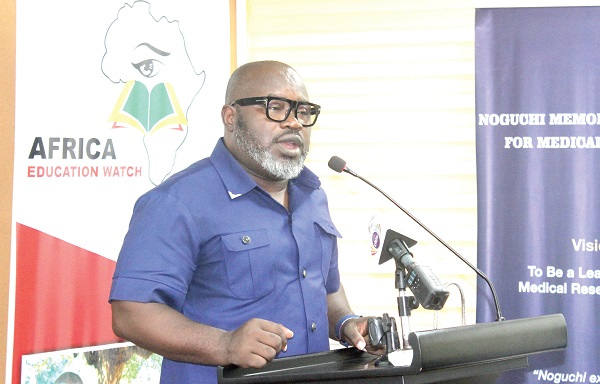
Africa Education Watch Executive Director Kofi Asare, is calling for schools to be granted authority to dismiss students whose behavior threatens safety and order, amid rising concerns over indiscipline in secondary schools.
Asare argues that traditional disciplinary measures, including corporal punishment, are no longer sufficient to address the current level of misconduct. “Schools must have the power to dismiss students whose conduct threatens safety and order,” he stated.
This comes as teacher unions advocate for reinstating corporal punishment to curb indiscipline. Asare agrees the ban on corporal punishment has contributed to the issue but believes reintroduction wouldn’t be enough to address the problem.
Recent incidents include violent clashes and suspensions in several senior high schools, highlighting growing concerns over student behavior.