


The press once held the sword of truth. Today, many hold the President’s briefcase.
It was the age of Kweku Baako Jnr., Kofi Coomson, and Prof. P.V. Ansah — towering voices who turned journalism into a civic shield against military boots and party brutality. Their courage, in alliance with civil society, exposed the AFRC and PNDC’s human rights abuses. They stripped the P(NDC) of its propaganda cloak and ushered in the dawn of constitutional democracy. The media was fearless. It stood tall — the true Fourth Estate of the Republic.
But history took a sharp turn.
After the NDC’s 2000 electoral defeat, they did not sulk — they strategized. They saw clearly what the NPP failed to grasp: in a democracy, the airwaves are the new arsenal.
While the NPP basked in its early 2000s victories, drunk on constitutional legitimacy, the NDC went to work. Quietly, they began recruiting media minds, sponsoring media startups, buying airtime, building alliances. They knew what they were doing. By 2012, media houses weren’t just covering politics — many had merged ideologically with it.
Today, the numbers are staggering. Out of 549 active licensed FM stations in Ghana, over 410 are NDC-owned or NDC-aligned. Out of 135 active TV stations, more than 120 lean toward the NDC orbit. And the biggest players — Multimedia Group (Joy FM, Joy News, Adom FM) and Media General (TV3, Onua TV, etc.) — alone command over 50% of national listenership and viewership. Both have gone politically green.
In contrast, the NPP — rigid, risk-averse, and almost aristocratically indifferent — failed to adapt. They assumed that good governance alone would win the media’s affection. Worse, under Akufo-Addo, they reportedly refused to “play financial football” with key media houses, choosing austerity over patronage. That choice, while morally commendable, came at a political cost: the media turned from disinterested observers into hostile prosecutors.
From 2021 to 2024, mainstream media outlets opened unrelenting fire on the Akufo-Addo regime — often unfairly, sometimes maliciously, but always lethally. The NPP walked into an ambush they didn’t even know had been set. When the dust cleared in 2024, the party had suffered one of its most humiliating defeats in history. Some party voices now conveniently blame Dr. Bawumia — but the true betrayal came from a media landscape the party ignored, misread, and lost.
The silence of that media today, under John Mahama’s renewed presidency, is deafening. Take the CJ Torkornoo assault, for instance — a clear constitutional crisis. Yet no media of national repute has mounted editorial resistance. There are no front-page screams. No investigative documentaries. No balanced debate. What we hear instead is prosecution-by-broadcast, mostly aimed at the Judiciary, while shielding the Executive.
This is no longer a media ecosystem. It’s a captured communications infrastructure — weaponized, sanitized, and embedded in power.
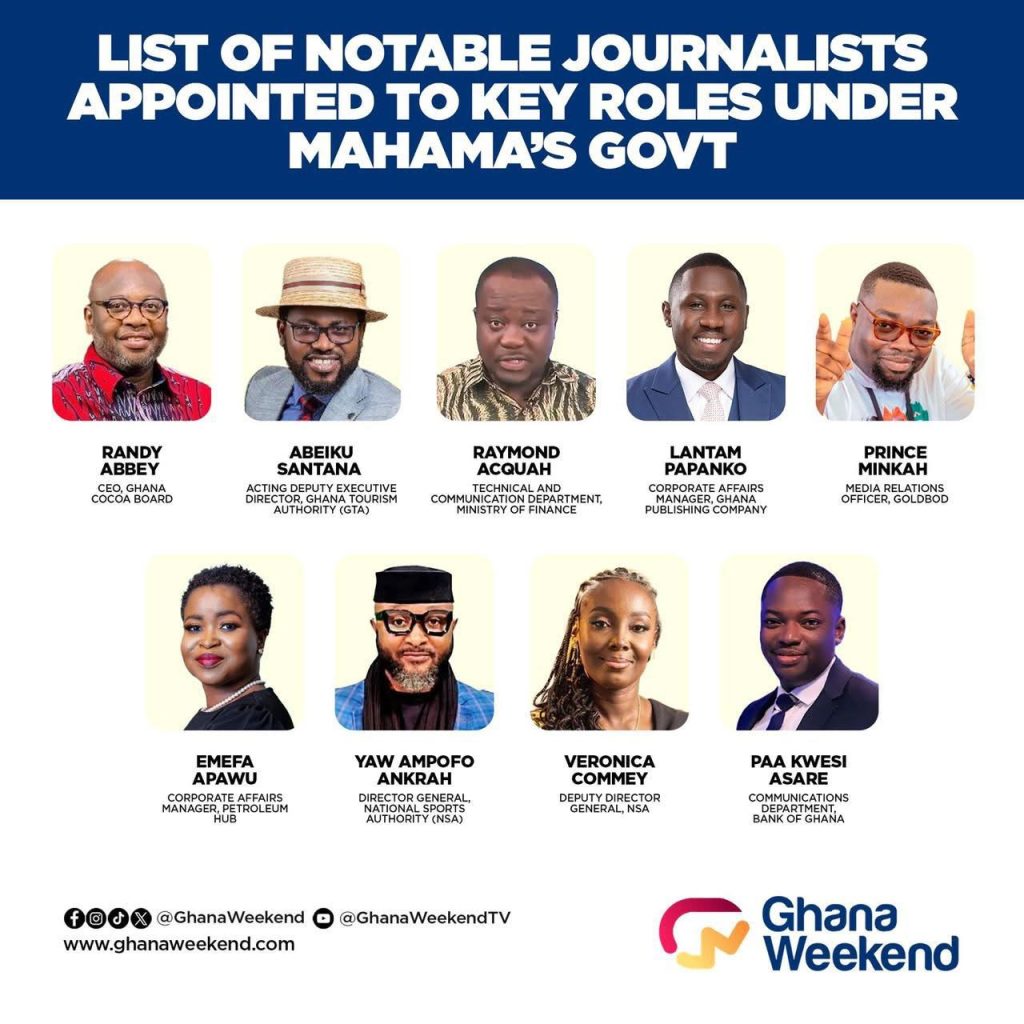
When journalists become presidential appointees, when editorial lines sound like Cabinet scripts, the Republic is no longer guarded. It is choreographed.
The NPP’s sin wasn’t only arrogance. It was lethargy in a high-speed political war. They underestimated the enemy. They overestimated their moral credit. And they forgot the simplest law in politics: you don’t win hearts — or elections — with silence.
The press once held the sword of truth. Today, many hold the President’s briefcase.
Ghana’s media, if you ask, may never rise as the Fourth Estate of Realm!
J.A. Sarbah
Political Observer | Voice of National Conscience
